
0%

In Part 3 of our Narrative Design series, we talk pre-production: what is it, why is it important, and the lore bible deliverables for it.
Blind Squirrel Design Department: Narrative Design Series
Author: Mimi Black, Narrative Producer & Designer
Support: Haydn Dalton, Creative Director; Nathan Sumsion, Lead Game Designer; Katherine Clare, Marketing & Communications Manager
Part 3: Pre-Production
In the ideation phase, we ironed out core concepts that drive the game’s fantasy, gameplay, and tone. In pre-production, we will iterate on those ideas, adding more structure to the foundation that will allow all necessary departments to start building a game.
The following outlines our ideal pipeline for pre-production. Ideal. Never actual. That doesn’t exist in game development. This pipeline should be adapted depending on the nature of the game, timeline for development, and at what phase you’re brought into the development process (prayers for those doing all these steps at once while also writing, recording and implementing two months after you were supposed to ship).
(Here is an overview of our pipeline deliverables for each phase of development. Each phase will get its own deep-dive post in the coming weeks.)
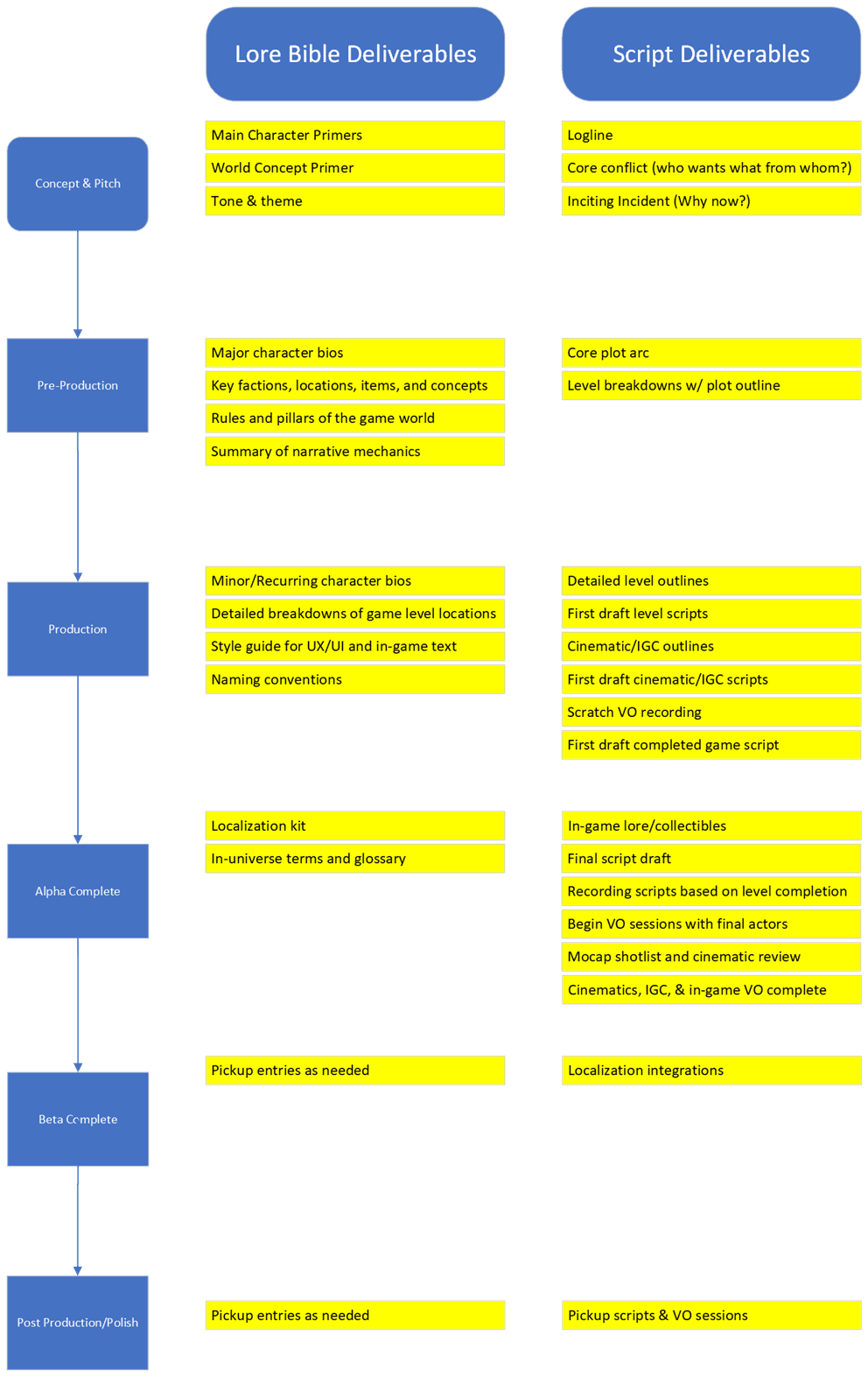
Lore/World Building
This section and the next tend to happen simultaneously – you often need to flesh out the lore to inform critical parts of your story or character. If you haven’t started a lore bible yet, now is the time. This can be a Word document or PowerPoint, or it can be stored in an application like Confluence which works like a wiki. World building is a continual process. You will edit your lore bible over and over until the very end of production as collaboration and changes in scope morph the game. Make sure you are updating the lore bible regularly so that everyone is on the same page. Along with key pieces from the ideation phase (such as pillars, tone, themes, core conflict, and fantasy), you will make entries for the following, if applicable. We use templates for these to ensure consistency.
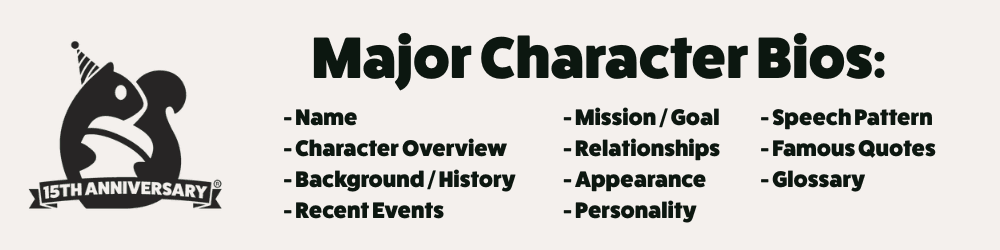
Major Character Bios
These should include:
- Name
- Character overview
- Background/History
- Recent events
- Mission/Goal (Include the goal that will drive the player’s action, but I also list the character’s Wants versus their Needs. Usually, what a person wants is at odds with what they need to grow.)
- Relationships (that are relevant to the story and backstory)
- Appearance
- Personality and character
- Speech pattern
- Famous quotes (Quotes can give readers quick insight into a character)
- Glossary (If you’ve mentioned any factions, items, locations, or other specialized terms a reader might not know, define them in the glossary section.)
Here is an example character sheet featuring a character from our original game, Drifters. It was a 5v5 hero action shooter with minimal plot, basically just a narrative wrapper, but with a lot of fun characters:
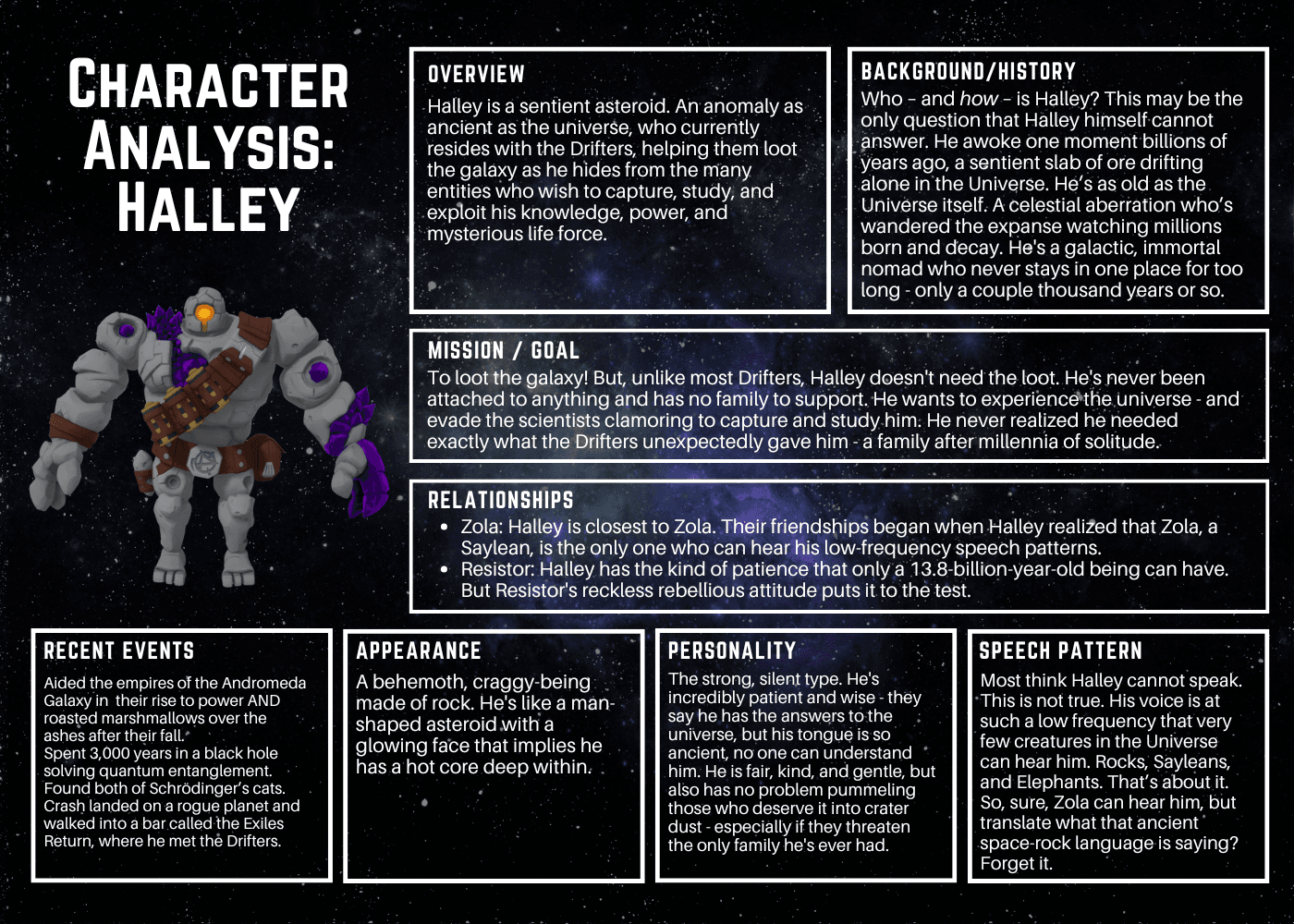 Glossary:
- Drifters - A ragtag group of intergalactic raiders who live on the outskirts of the universe and survive by looting the galaxy.
- Exiles Return - The bar where the Drifters spend most of their time and await their next job.
- Saylean - An alien species known for their hunting and tracking skills, helped by their precise hearing.
- Resistor - Anarchist A.I. and the Drifters' explosives expert.
The World
Include an overview of the world at large. Give key locations their own pages that can be linked within the world page.
Key Factions, Locations, Items, and Concepts
Factions are any group that has a significant role in your game’s story. They can be political entities, religious groups, military orders, social movements, guilds, cultural identities, and more. Include details on their…
- History
- Culture/society
- Religious beliefs
- Mission
- Rivals, allies and enemies
Each distinct location should have its own entry. Include…
- History/lore
- Details on its geography, topography, flora and fauna, and any natural hazards that could impact level design
- Key resources
- Any settlements, landmarks or points of interest
- An overview of its inhabitants and their cultures or factions
- Any notable people from the game/story
- Important story notes
- Glossary of terms
Items should only get entries if they’re important. Explain why the item is significant and give us its origin/history, appearance, and current location.
If you have any major concepts that impact the world, define them and explain their significance. Something like the Force in Star Wars would be an example.
Rules, Pillars, and Themes of the Game World
We discussed pillars in the previous post on ideation here. These are foundational principles that inform how the narrative is conceptualized and integrated.
Rules are laws that make your world consistent. If you abide by your own rules, the world should be believable, no matter how insane the concept. Break the rules, and you risk breaking your audience’s suspension of disbelief. Some areas to consider for defining rules (These are also great for world-building in general):

Magic and technology Who uses it? How does it work? How advanced? What’s the cost? Is it learned? Who has access? What’s possible and what isn’t? Is magic innate or learned? Examples:
- Star Trek: Warp travel is possible but consumes massive amounts of antimatter and dilithium and has certain restraints, ignoring which can tear subspace and destroy your ship.
- The Witcher: Only trained humans can channel the Source (In Harry Potter and Star Wars, magic/the Force can only be accessed by those with innate ability; in Doctor Strange sorcery is learned.)
- StarCraft: Protoss technology requires Psionic energy.
Politics and government Who holds the power? Who wants it? Who cannot have it? What are the laws and who enforces them? Examples:
- Star Wars: The Republic’s downfall is built into its political laws: the Empire rises because emergency powers override democracy and allow for dictatorship.
- Judge Dredd: Mega-Cities are authoritarian states run by Judges, who are police, judge, jury, and executioner all in one.
Religion How much influence does religion have? Are there many religions? Are deities fact or myth? What are the morals of the world? Examples:
- Game of Thrones: Different religions access different supernatural systems.
- Star Wars: You have the Sith and Jedi: religion is at the center of everything (and politics).
Physics and cosmology How do matter, energy, and the universe differ from our own? What’s possible? What’s impossible? Was creation different? Examples:
- Star Wars: the Force permeates all matter, and the Light and Dark sides are cosmic laws with morality manifesting as cosmology.
- Marvel Universe: It contains multiple overlapping dimensions governed by unique physical laws.
- The Witcher: The magic system is based on the Conjunction of the Spheres - overlapping worlds resulted in monsters and magic bleeding into the human world.
Flora, fauna, climate, and geography Geography dictates culture (and can shape conflict when it goes wrong). What sort of terrain produces the cultures of your universe? How have they adapted? Where are your main characters on the food chain? Does nature rule? Has it been wiped out? Examples:
- Halo: The environment is engineered, the climate is artificial, and the wildlife is programmable.
- Lord of the Rings: Geography reflects moral/metaphysical alignment. Volcanic Mordor is home to the corrupt. Fangorn Forest is sentient but slow in its consciousness.
Social rules and class systems Few things in society shape conflict more than social hierarchies. What kinds exist in your world? Who are the elite? How do they display this? Are certain classes associated with certain jobs, skills, or geography? Examples:
- Hunger Games: Districts are rigidly stratified, align with a specific industry, and one cannot leave their district without permission. Class defines survival odds.
- Cyberpunk 2077: Social mobility is tied to wealth, tech access, and street cred. Status shapes survival and opportunity.
History and time What events shaped the modern culture of your world? What rivalries linger? Is time travel possible? How does time move? Does it work the same for everyone? Can it be manipulated? Examples:
- Assassin’s Creed: Historical events are immutable; users access them through genetic memory. The Animus allows historical observation, not alteration.
- The Legend of Zelda: Ocarina of Time: Link can move between child and adult times, but the world remains consistent in each era. Changes in one time affect certain outcomes, but not all.
- The Witcher: While also a cosmological event, the Conjunction of the Spheres is integral to the world’s history and its impact on how you play.
Not all of these will be applicable to the world you’re creating, but it’s good to review that list and consider whether these categories bear a significant impact on your world order.
Themes were also discussed in the ideation phase, but if you’re working on an original concept, themes probably aren’t cropping up until you dig into the story and lore bulding. Start identifying them and include them in your bible.
Summary of Narrative Mechanics List and explain the narrative mechanics you will develop. Have a unique dialogue system? Are roleplaying stats driven by personality traits like in Disco Elysium? Does time rewind? Do aspects of the game contribute to your psychological decline? Are you using a time loop mechanic? Do choices have consequences?
Conclusion
We will stop here. Phase one of pre-production requires a lot of templates and world-building. This is the fun part! But also… as a game writer, you often don’t have a lot of time. It is very easy to get bogged down in research and details, then lift up your head and realize it’s time to start plotting the narrative, but all you have is your character’s family tree tracing back 300 years. Focus on the high-level features of the universe, the ones that get the picture across quickly, then you can fill in all those little details later.
Things to look forward to in Pre-Production Phase Two:
- Plot and Character Development
- Narrative Structure
- Art Guidelines and Visual Identity
- Main Story Outline
- In-engine Implementation Pipelines
- Implementation Protocols for Narrative Elements, Text & Audio
- Level Breakdowns with Plot Outlines
- Legal Reviews
See you again soon!
LATEST NEWS
Blog
12.12.25
15-Year Retrospective - Part 4: Fifteen Years of Building, Learning, & Looking Ahead
Blind Squirrel Games Admin
As Blind Squirrel Games celebrates its 15th anniversary, the past few years have marked a period of bold transformation and resilience. From expanding BSG’s global footprint with the acquisition of Distributed Development in Colombia to balancing its legacy of ports and remasters with ambitious creative ventures, the studio has embraced change while staying true to its roots.
Blog
12.10.25
Scalability: How Blind Squirrel Meets Demanding Project Needs
Blind Squirrel Games Admin
Great development cycles demand great planning. See how BSG forecasts staffing, welcomes new talent, and adapts as project scopes evolve.
Blog
12.01.25
15-Year Retrospective - Part 3: Boss Fights and Breakthroughs
Blind Squirrel Games Admin
By the late 2010s, Blind Squirrel was entering a pivotal era. After years of success with ports and remasters, the studio began charting a new course, one that would expand its creative ambitions and global footprint.
Blog
10.13.25
Narrative Design Series Part 2: Planning & Ideation
Mimi Black, BSG Design Department
In Part 2 of our Narrative Design series, we explore: what does a narrative development pipeline look like? The pipeline starts with planning and ideation, which is what we will explore here.
Events
09.23.25
BSG at NZGDC: Sharing Lessons, Sponsorship, Cosmorons
Blind Squirrel Games Admin
BSG at NZGDC 2025: Three Speakers, Sponsorship, and Cosmorons at Kiwi Games Zone!
Blog
09.15.25
Narrative Design Series Part 1: Intro to Narrative Design
Mimi Black, BSG Design Department
Stories are the backbone of great games. In Part 1 of our Narrative Design series, Blind Squirrel’s design team breaks down the fundamentals of building worlds that players want to live in.
Blog
08.12.25
15-Year Retrospective - Part 2: Leveling Up
Blind Squirrel Games Admin
Between 2013 and 2016, Blind Squirrel Games evolved from a strike team studio into a full-fledged production powerhouse. This period saw the studio’s first big breakout with Bioshock: The Collection, the development of new business infrastructure, and its expansion to new industry partners. Hear from CEO Brad Hendricks, COO Matthew Fawcett, and Director of Project Management Office Drew Bradford on BSG’s expansion.
Blog
06.06.25
15-Year Retrospective - Part 1: The Spark
Blind Squirrel Games Admin
15-Year Retrospective - Part 1: The Spark In 2010, Brad Hendricks lost his job and bought a house in the same week. Most people might have panicked. Brad? He started a game studio.
Newsletter
03.07.25
Blind Squirrel Newsletter: Q1 2025
Blind Squirrel Games Admin
Catch Us at GDC 2025 – New Studios, New Games, and More!
News
02.05.25
Colombian Studio Acquired by BSG
Blind Squirrel Games Admin
BSG has acquired Distributed Development, a Colombian game studio, to enhance its global presence and drive cost-efficient AAA game development.
News
12.05.24
Cosmorons Featured in Xbox Winter Game Fest 2024
Blind Squirrel Games Admin
Cosmorons Featured in Xbox Winter Game Fest 2024
News
11.21.24
Blind Squirrel Games Announces Cosmorons, an All-New, Original Intergalactic Arcade Shooter
Blind Squirrel Games Admin
Cosmorons: Now in development, players will blast into the cosmos to take on galaxies in pursuit of ‘Ultimate Glory’
News
10.11.24
CEO Brad Hendricks Interviewed on Game Dev Advice Podcast
Blind Squirrel Games Admin
Brad dives into topics like starting your own studio, self-publishing, and more on the Game Dev Advice podcast!
News
06.13.24
Delta Force: Hawk Ops - Blind Squirrel Games Announces Involvement
Blind Squirrel Games Admin
Blind Squirrel Partners with TiMi and Team Jade on New Delta Force: Hawk Ops Game
News
06.12.24
New World: Aeternum Consoles Release - Blind Squirrel Games Working Alongside Amazon Games
Blind Squirrel Games Admin
Blind Squirrel Games Working Alongside Amazon Games on New World: Aeternum Console Release
News
06.11.24
State of Decay 3 - Blind Squirrel Games Named Co-Development Partner
Blind Squirrel Games Admin
Blind Squirrel Games Named Co-Development Partner in State of Decay 3
News
05.07.24
New World: Winter Rune Forge Trial Deep Dive
Blind Squirrel Games Admin
Join Environment Artist Carlos Lopez for a glimpse into how the Art Team brought our latest Seasonal Trial to life.
News
03.30.24
BSG Interview with Game File
Blind Squirrel Games Admin
CEO Brad Hendricks shares insights on publishing trends, forward-thinking development, and next-gen backwards compatibility.
Events
02.06.24
Blind Squirrel Games Sponsors DICE Summit 2024: Game Changers
Blind Squirrel Games Admin
Blind Squirrel Games is a proud sponsor of DICE Summit 2024: Game Changers
News
01.12.24
BSG Interview with CanvasRebel
Blind Squirrel Games Admin
Meet Brad Hendricks, the biggest trends emerging in your industry, leading creative teams, and more
News
01.10.24
2024 gaming industry predictions featuring BSG CEO Brad Hendricks
Blind Squirrel Games Admin
More AI, fewer risky bets, and finding footing in a changing industry: Industry professionals share their opinions of what may shape the games sector this year
News
09.08.23
Blind Squirrel Games Rebrands to Mark its Growth in Gaming
Blind Squirrel Games Admin
Blind Squirrel Games Rebrands to Mark its Growth in Gaming
News
08.27.23
Blind Squirrel Games gives Keynote at NZGDC
Blind Squirrel Games Admin
BSG Gives NZGDC Keynote: Building a Better Workplace for Better Games
News
03.08.23
Brad Hendricks Gives Interview at DICE 2023
Blind Squirrel Games Admin
Las Vegas Review Journal Interviews Brad Hendricks on LAN Parties Podcast
We use cookies to improve your experience. By using this website you agree to our Cookie Policy.